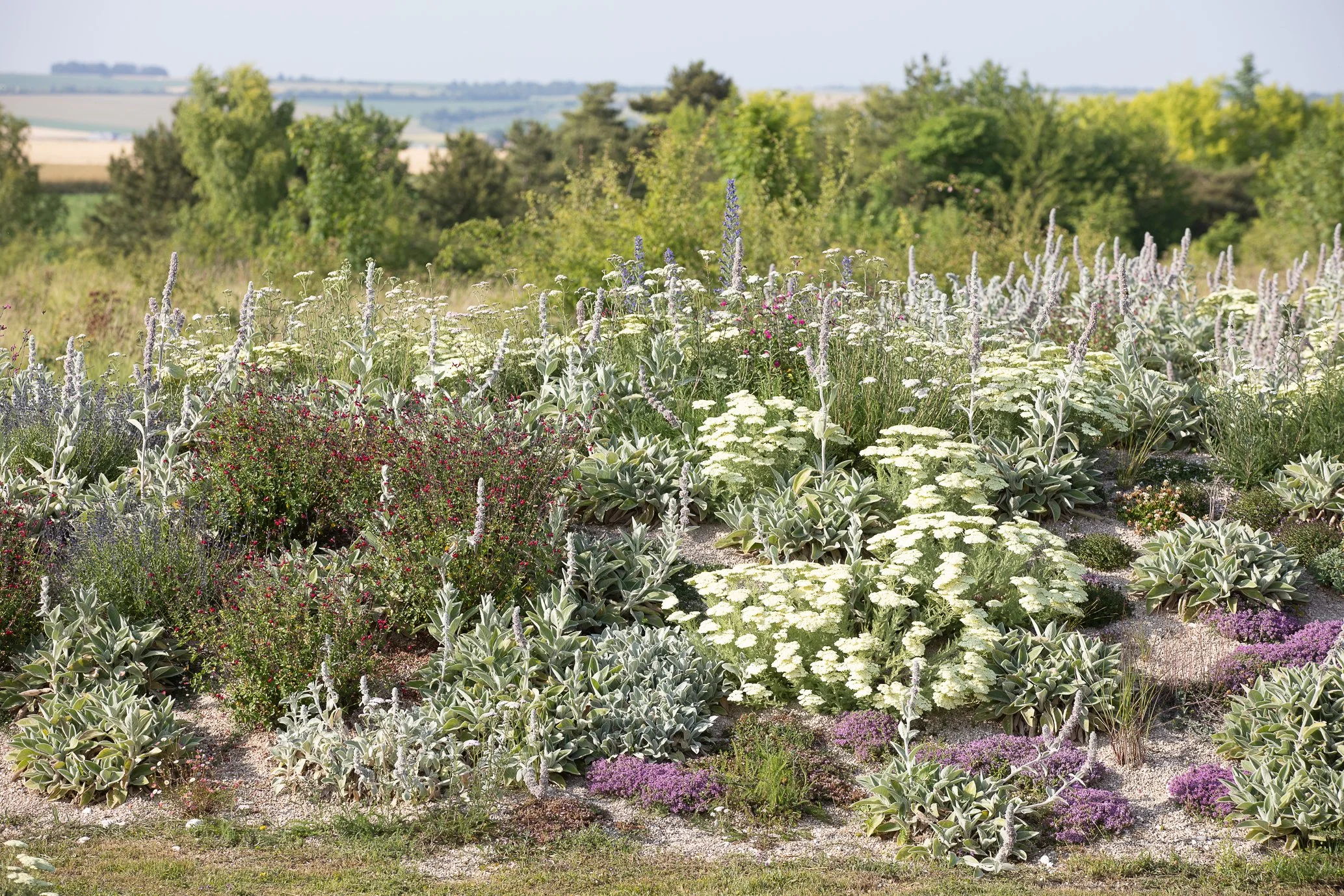
Paris, summer 2003: a severe heatwave strikes the capital. In July 2019, the temperature reaches 42.6°C. What comes next? Météo-France climate projections suggest that heat episodes could approach 50°C by the end of the century.
In cities, the urban heat island effect pushes temperatures even higher. Some neighborhoods can be several degrees warmer than the surrounding countryside. This is no longer a distant scenario. It is already a reality we encounter every day in our work as landscape architects in Paris.
I am David Simonson, landscape architect and founder of Simonson Landscape, a Paris-based landscape design studio established in 2015.
My relationship with landscape began long before that, in San Diego, California, where I grew up and first started working with plants and soil. The dry climate, intense light and Mediterranean vegetation of the Californian coast profoundly shaped the way I design gardens.
Today, that experience informs our work in Paris and across the Île-de-France region. We design gardens that can withstand periods of extreme heat, manage water more carefully, support biodiversity and remain beautiful throughout the seasons. These are landscapes adapted to their environment: more resource-efficient, more alive and designed to last.
What California Taught Me About Drought
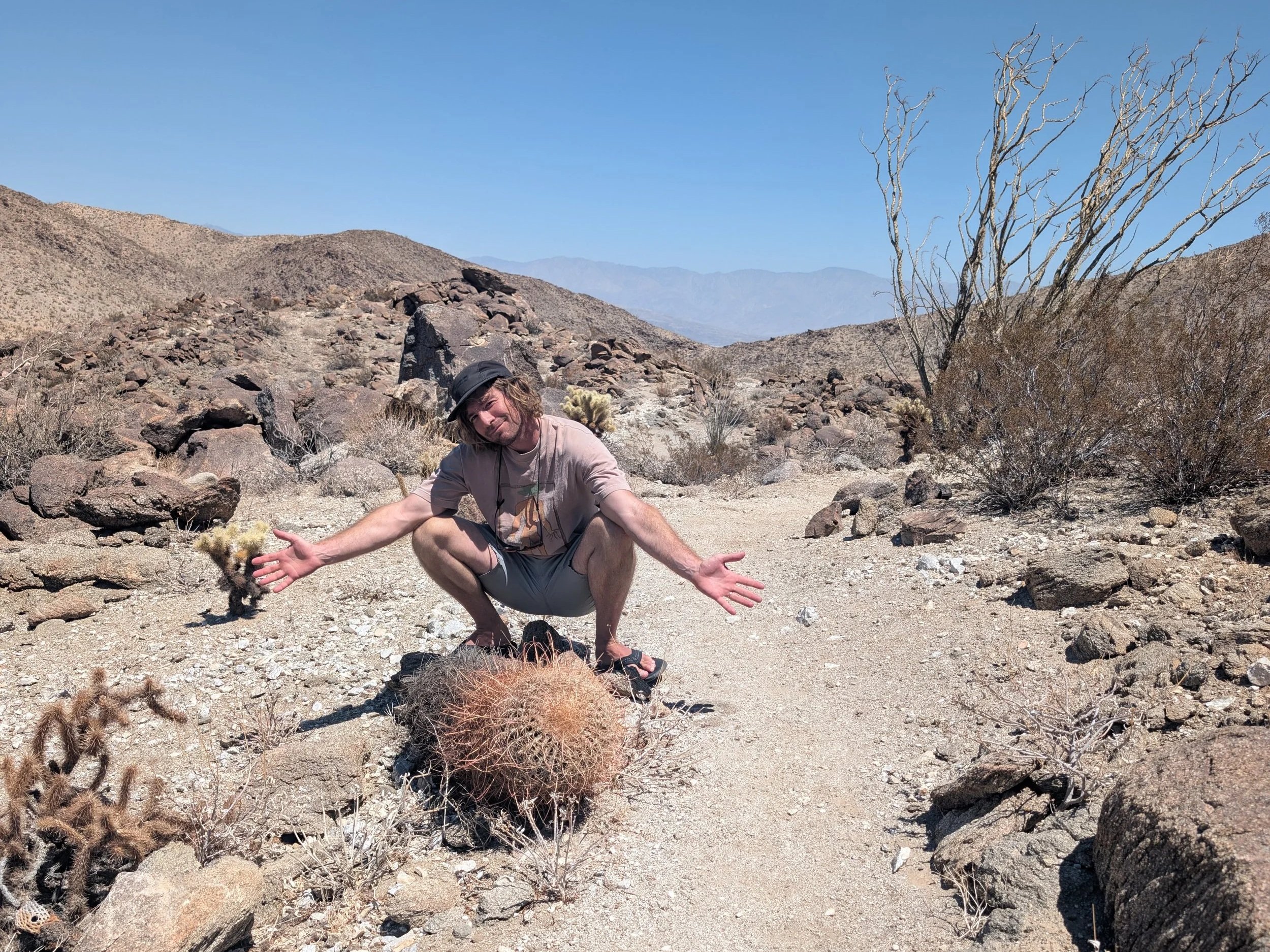
Growing up in Southern California means learning early that water is neither free nor guaranteed. We washed using a bucket so the water would not be wasted. The rule at home was simple: “If it’s brown, flush it down; if it’s yellow, let it mellow.” Drought was not a political debate or a future climate scenario. It was Tuesday.
California chaparral, the dry, fragrant scrubland of the coastal hills, taught me what a landscape can achieve with almost nothing. Plants survive for months without rain, then flower in spring with unexpected intensity. Grasses turn silver in the heat. It is a mineral, wild landscape that, at the right time of year, is genuinely beautiful.
I brought this relationship with dry-climate planting with me to France. From the beginning, it has guided every resilient garden we have designed in Paris and elsewhere.
Urban Heat Islands: Figures Landscape Architects Can No Longer Ignore
The temperature difference between a dense Paris neighbourhood and the nearby countryside can reach 6.4°C. In mineral streets, on flat roofs and in asphalt courtyards, heat builds throughout the day and is not released until well after midnight. Conventional planting schemes were simply not designed for these conditions.
Under severe drought conditions, traditional landscaped spaces can lose up to 30% of their plants. These are not abstract losses. They mean wasted maintenance budgets, projects that must be replanted, and spaces that become visually and ecologically poorer after every heatwave.
ADEME and Cerema have documented climate-adapted planting as an important way to address urban heat islands. Plant selection is not a minor detail. It is central to any serious urban climate adaptation strategy.
The City of Paris has recognised this. In 2017, as part of its Resilience Strategy and Climate Plan, the city committed to transforming the grounds of 750 schools, a combined 70 hectares of hard surface, into cooling islands. The Oasis Schoolyard programme removes impermeable surfaces, introduces planting, replaces black asphalt with permeable materials, and adds trees and ground cover. This citywide undertaking demonstrates how plant selection, and the way the soil is prepared to support it, has become a priority for climate adaptation.
The good news is that there is a response. We have demonstrated it through a series of award-winning landscape projects.
Four Projects, One Conviction: Dry Gardens Can Be Remarkably Beautiful
Le Jardin des Émergences - Chaumont-sur-Loire, 2016
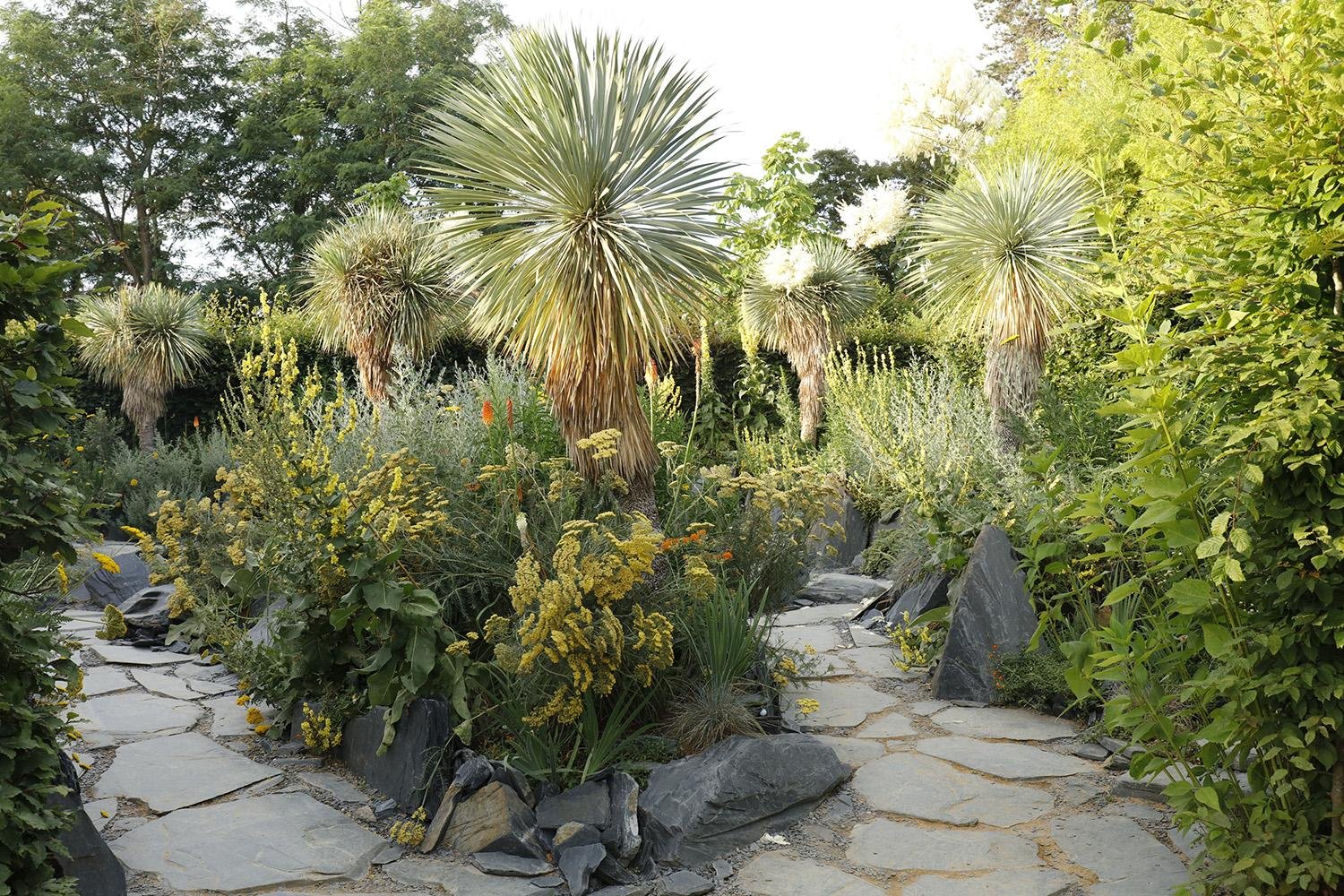
In 2016, we presented Le Jardin des Émergences at the International Garden Festival of Chaumont-sur-Loire. To our knowledge, it was the first xerophytic garden presented at the festival, one of Europe’s most demanding events in landscape design. The message was deliberate: a garden without irrigation need not be bleak, hostile or reserved for cactus enthusiasts.
The garden was floriferous, dense and fragrant. It combined Mediterranean perennials, dry grasses and summer-flowering shrubs. This planting palette responded to heat with generosity, not resignation. The project received the Plant Palette Award and helped change how dry gardens were perceived in France, not as gardens defined by constraint, but by conviction.
Le Jardin de la Sixième Extinction - Villa Rothschild, Cannes
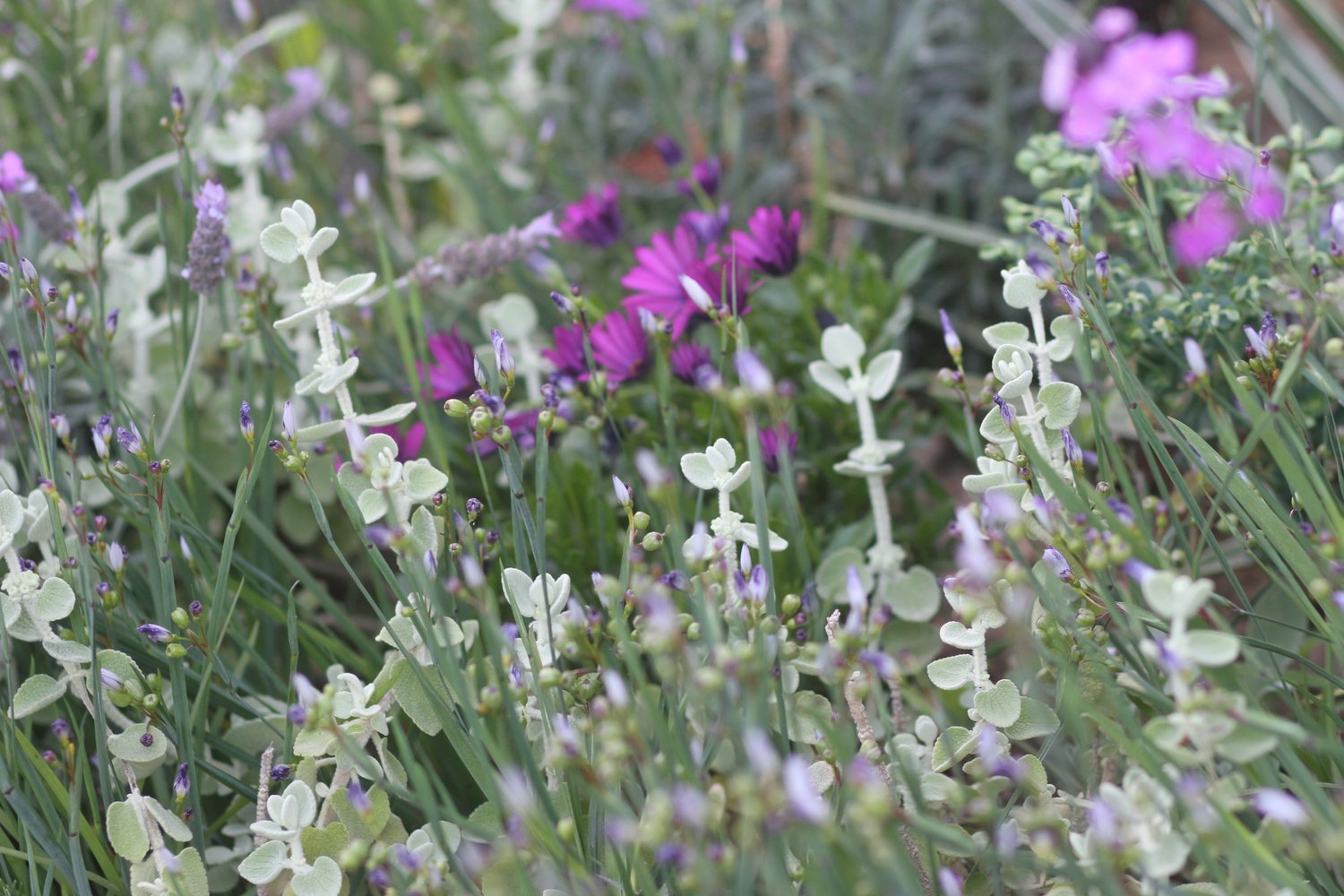
At Villa Rothschild in Cannes, we designed Le Jardin de la Sixième Extinction for the Côte d’Azur Garden Festival. The garden is a journey through time and through humanity’s relationship with the Earth. Primitive life forms appeared on our planet millions of years ago. Humans took their place around 200,000 years ago, learned from the Earth and gradually disrupted its balance. We now face a choice: continue exhausting the resources that gave us life, or reconnect with nature and restore a sense of balance.
Our dry garden tells this story through the plants themselves, rather than through explanatory panels, because the planting survives without irrigation. Drought is not simply a staging constraint. It is the subject of the design. The garden received the Public Prize.
Le Jardin des Murmures - Chaumont-sur-Loire, 2024
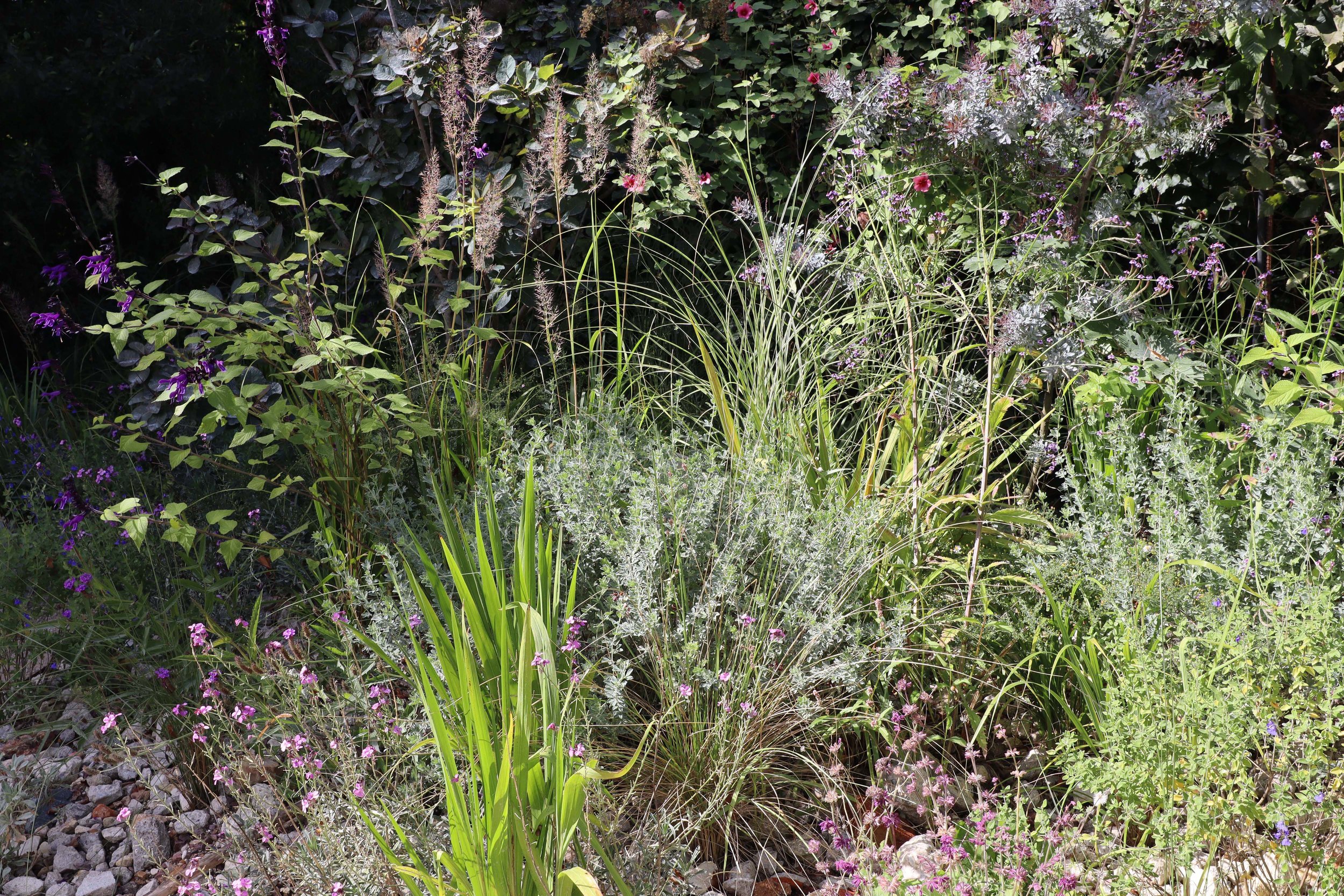
In 2024, together with our project partner Thibault Rouet, we returned to Chaumont with Le Jardin des Murmures. The garden received the festival’s Design Prize. It was another recognition of an approach that has remained consistent since 2016: a dry garden can be exceptionally beautiful, and the garden itself is the best demonstration of that idea
The American Peace Garden - Navarin, Marne
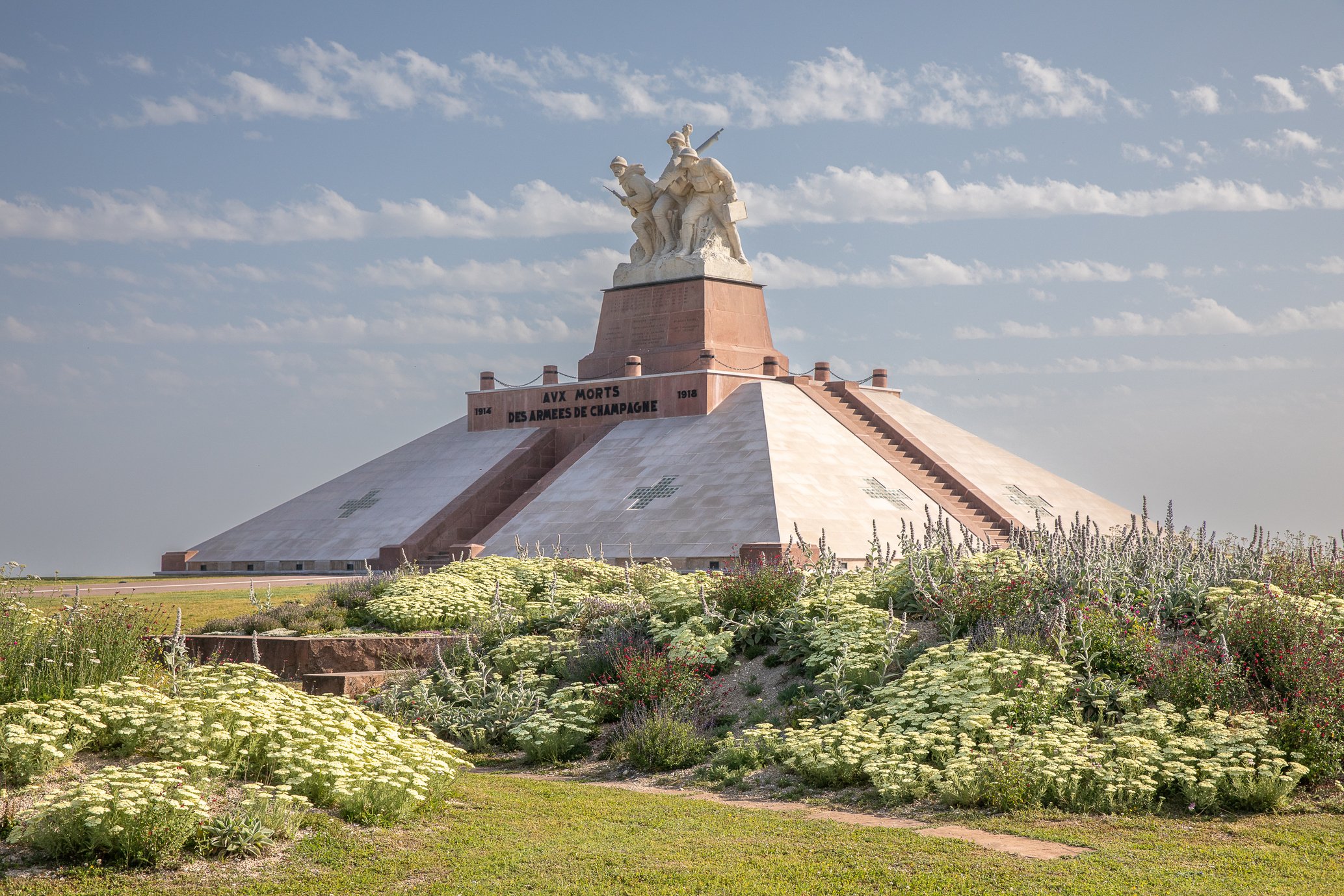
Created for Art & Jardins Hauts-de-France, the American Peace Garden is a memorial garden at the Monument to the Fallen of the Armies of Champagne and the Navarin Ossuary in the Marne. On a site marked by the Franco-American history of the First World War, we composed a garden designed to survive entirely without irrigation.
European and American species coexist in the same composition, all selected for their ability to withstand dry soils and difficult climatic conditions. It is a garden of remembrance that can endure without constant intervention. There is something fitting in that.
Different Types of Dry Garden: From Gravel Planting to Sedum Roofs
A xerophytic or non-irrigated garden is not one single garden type. It is a family of approaches, each suited to a particular context, topography and budget. These are the principal forms we design and recommend in Paris and the Île-de-France region.
Gravel Gardens
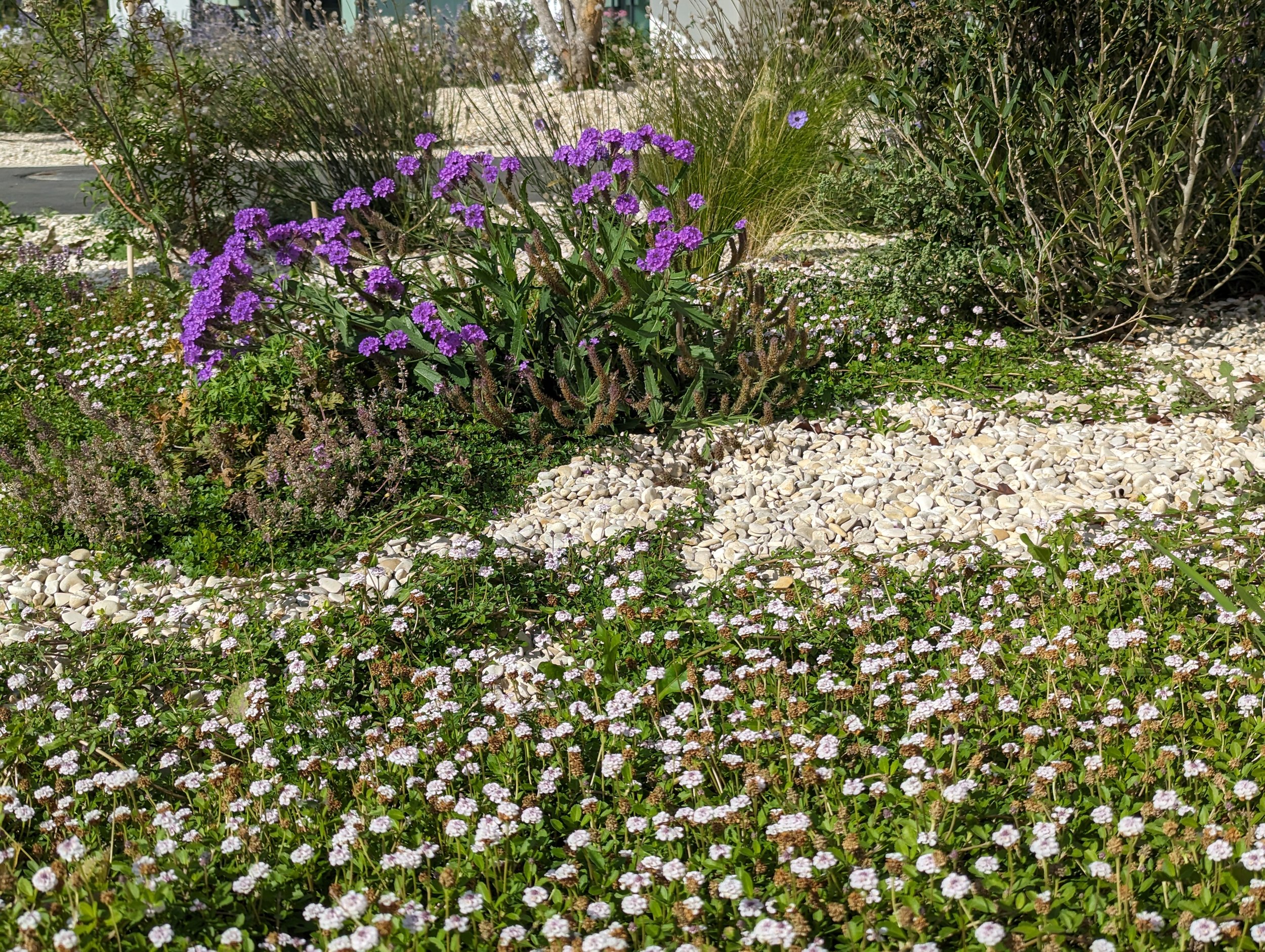
A gravel garden is often the most accessible way to convert an urban space. It combines free-draining soil, a mineral mulch that reduces evaporation and suppresses weeds, and a selection of adapted perennials and shrubs. In summer, the surface reflects heat and creates a microclimate well suited to Mediterranean plants. In winter, gravel keeps the crowns of plants clear of stagnant moisture, which is where rot begins, rather than at the roots.
Typical plants include lavender, Phlomis, Stipa, euphorbias, yarrow, Santolina and Artemisia.
Contemporary Rock Gardens
The rock garden is far from the outdated feature it is sometimes considered to be. Reinterpreted with a contemporary eye, it is one of the most effective solutions for slopes, retaining walls and areas that are difficult to plant. Gaps between the stones create microhabitats with cooler conditions below, excellent drainage and accumulated warmth at the surface. Alpine and Mediterranean plants have long adapted to precisely this environment.
Typical plants include Sedum, Sempervivum, thyme, Silene, Dianthus, Armeria and Arabis.
Sedum Roofs
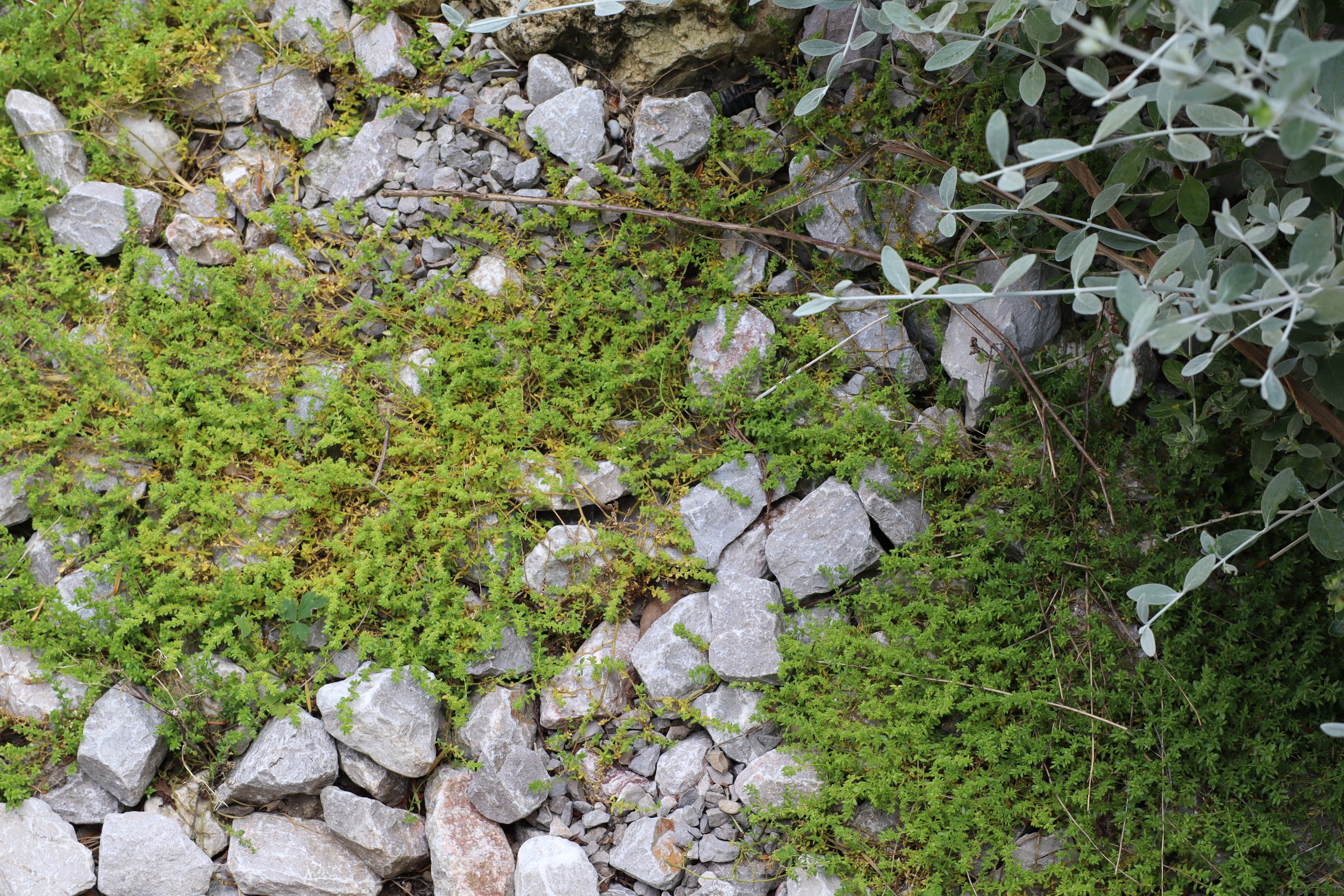
With only 8 to 15 cm of growing medium, mats of Sedum and other succulent plants can establish, help insulate a building, retain some rainwater and lower surface temperatures by several degrees. Once established, a sedum roof requires almost no irrigation and very little maintenance. We increasingly integrate them into Paris projects, including extensions, garages and the flat roofs of outbuildings.
Naturalistic Dry Meadows
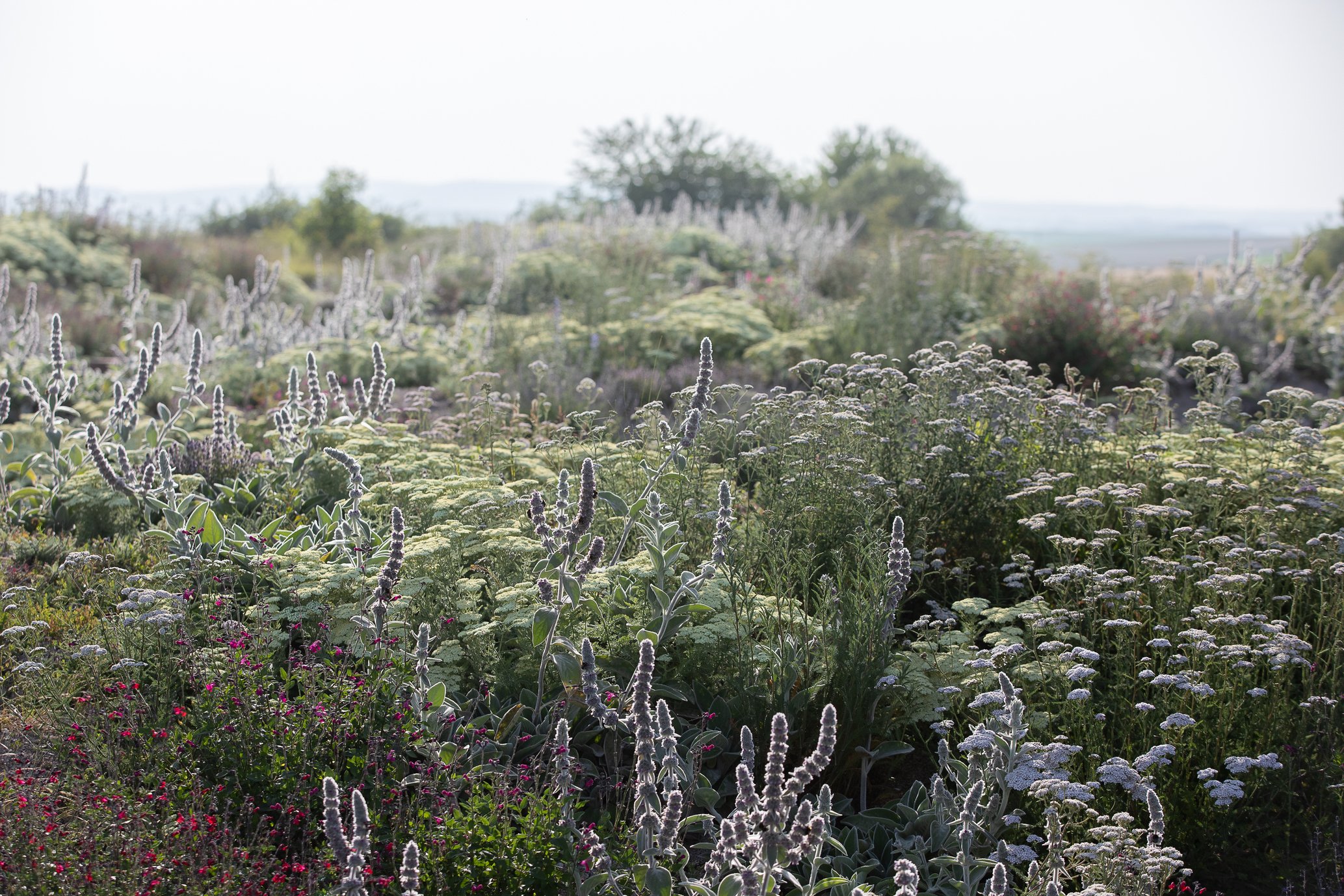
Inspired by calcareous grasslands and steppes, a naturalistic dry meadow combines fine grasses with perennials that flower mainly in spring and early summer. It can replace a conventional lawn in sunny areas, with maintenance reduced to one cut at the end of winter. The result is alive, moves with the wind and supports pollinators.
Typical species include Festuca glauca, Nassella tenuissima, Echinacea, Knautia macedonica, Salvia nemorosa and Verbena bonariensis.
Urban Garrigue Gardens
This approach takes its inspiration from the landscapes of southern France but can be adapted successfully to Paris with the right exposure. Once the plants are established, irrigation is unnecessary. The soil can be poor or even stony, which is often preferable. Of all these garden types, it feels the least like a constructed landscape and the most like something that might always have been there.
Typical plants include Cistus, rosemary, broom, Coronilla, Gaura, Agapanthus and Centranthus.
Courtyards and Terraces in Dense Urban Settings
In Paris, the principal constraint is often structural loading on a terrace or partial shade in a courtyard. Even in these situations, planting with minimal irrigation is possible. Terraces can use lightweight growing media containing pozzolan or expanded clay. Suitable courtyard plants include Epimedium, hardy geraniums, hellebores and drought-tolerant ferns. These are not compromise plants. They are the right plants for the right place.
Improving a Dry Garden by Making the Soil Poorer
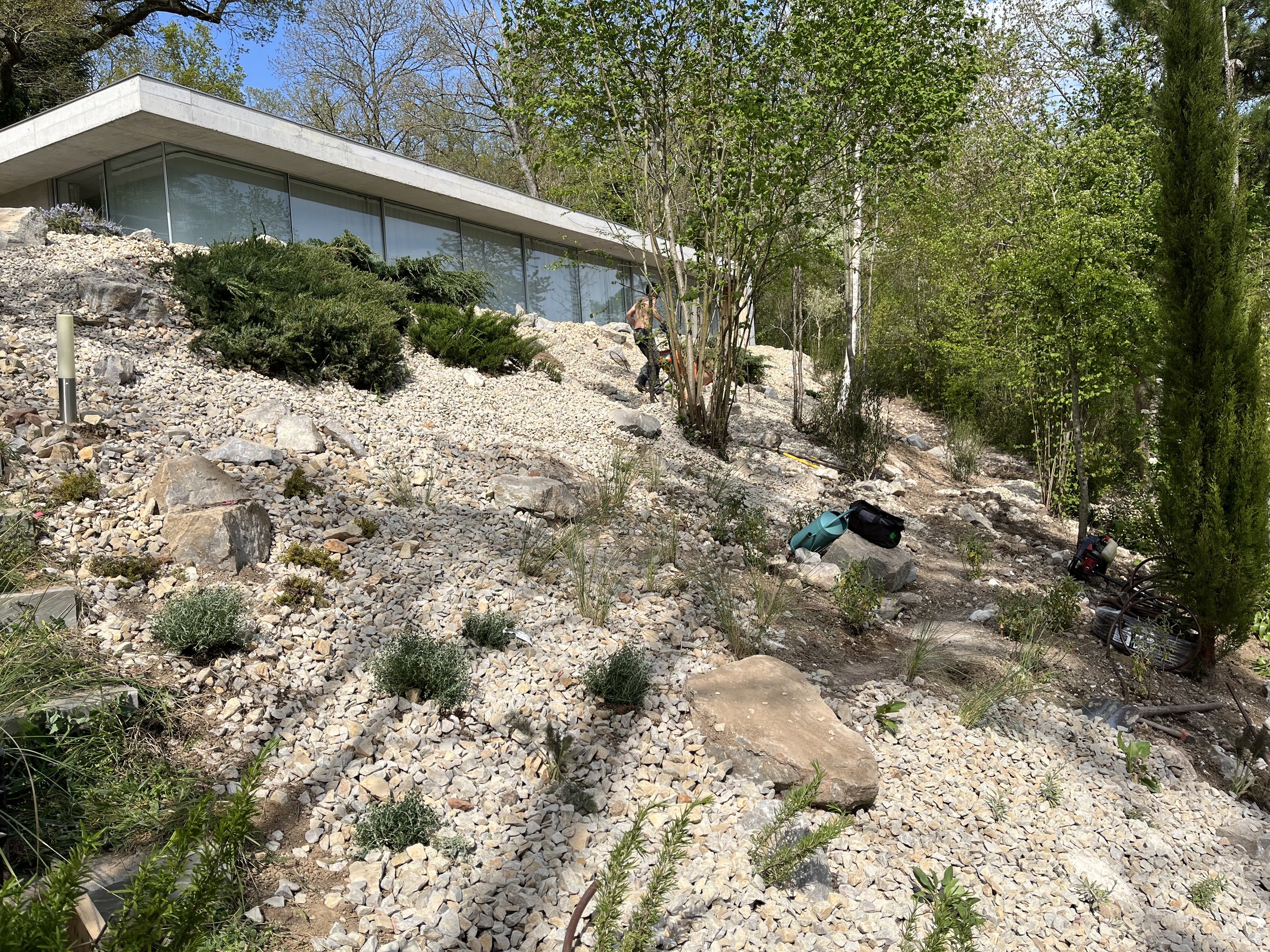
We explain this to almost every client: to create a dry garden that lasts, it is often necessary to make the soil poorer rather than richer.
Mediterranean and steppe erophytes evolved over millions of years in lean, stony soils with little organic matter. Their roots know how to search deeply for water precisely because very little is available at the surface. Plant them in soil that is too rich or retains too much moisture, and they develop shallow, dependent root systems, the exact opposite of what we want. Worse, their crowns can rot when exposed to stagnant winter moisture, even at our latitude.
How We Prepare the Soil
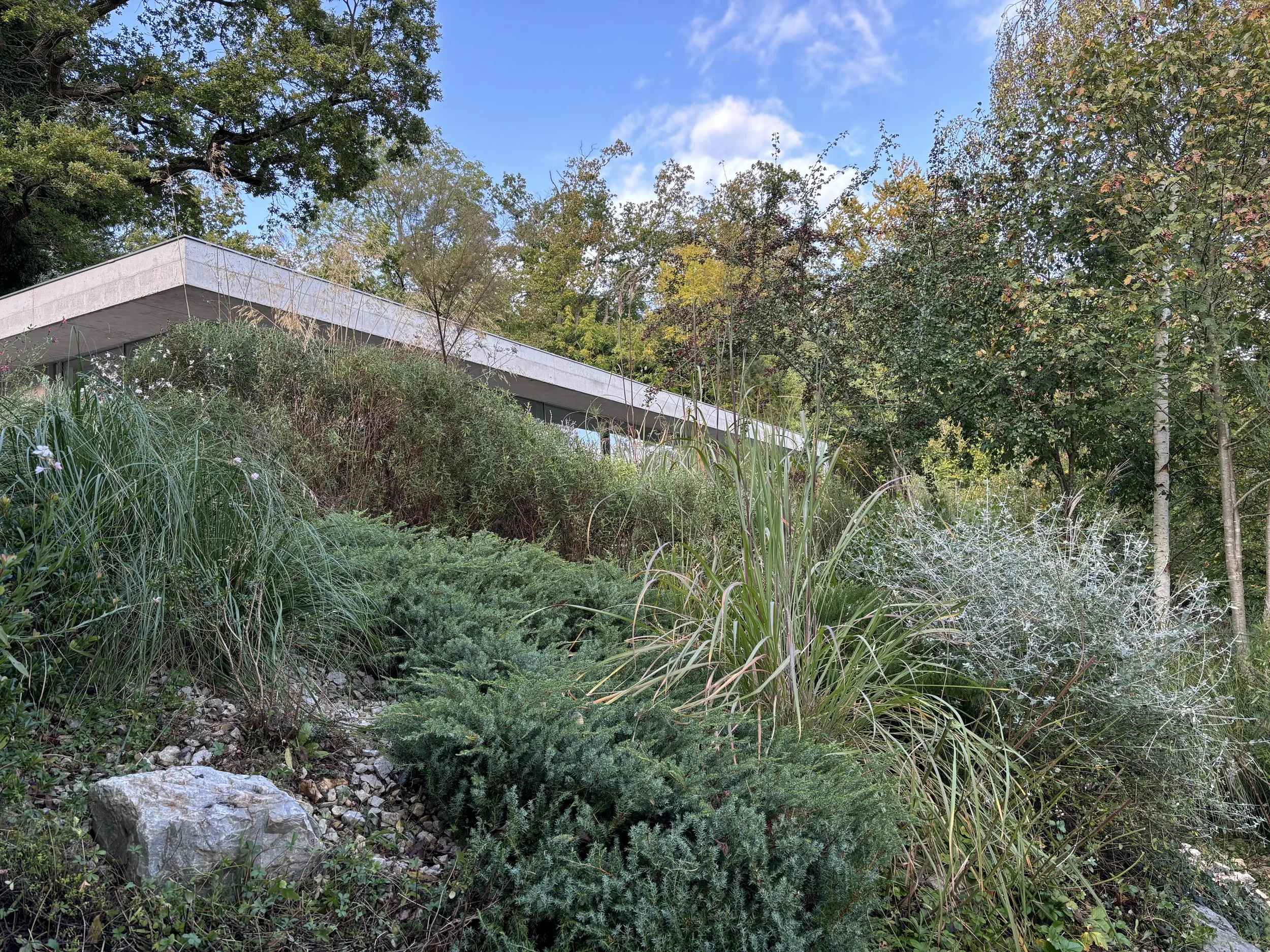
Drainage is the basis of every successful dry garden in Paris. Soils in the Île-de-France region are often silty or clay-rich. They retain water well, which is precisely the wrong property for xerophytic plants.
When preparing the soil, we regularly incorporate 30 to 40% draining material by volume. Coarse Loire sand, rather than fine marine sand that can compact and clog the soil, is a useful reference material. Combined with 5/10 mm gravel, it creates a porous structure that allows water to drain quickly and roots to descend without encountering saturated ground. For planting beds on terraces or in containers, we sometimes add a drainage layer of pozzolan at the base.
Mineral Mulch: The Other Essential Step
A 5 to 8 cm layer of mineral mulch, such as river gravel, crushed slate, pozzolan or limestone gravel, reduces evaporation by 30 to 40%, suppresses weeds and keeps plant crowns dry. This is critical in winter. The vulnerable point is not the root system, but the place where the plant meets the surface of the soil. Mineral mulch addresses this problem over the long term while giving the garden the coherent mineral character that forms part of its visual identity.
Avoiding Fertiliser Is a Technical Decision
Nitrogen encourages plants to produce rapid growth: soft leaves and stems that are less resistant to heat and drought. Plants receiving abundant nitrogen can also be more susceptible to disease and insects. In our dry gardens, established xerophytic plants receive no base fertiliser. We prepare the soil correctly once, then allow the plants to settle into the conditions for which they are adapted.
Principles That Guide Our Dry Garden Designs
Prioritise deep-rooted plants. Mediterranean and steppe plants seek water far below the surface. Once their root systems are established, generally after one or two full growing seasons, they need very little intervention.
Understand summer dormancy as adaptation, not failure. A lawn turning brown in August does not mean the garden has failed. It means the planting is responding to its conditions. Fine fescues and meadow mixtures can withstand a heatwave without irrigation and turn green again with the first autumn rain.
Work with reflected heat, rather than against it. Urban walls and paved surfaces accumulate heat. Some plants thrive in these conditions, including Stipa tenuissima, Perovskia atriplicifolia, Centranthus ruber and many forms of Salvia. They are not second choices. They are the right choices.
Train plants to become independent from the beginning. Excessive watering during the first years produces shallow, dependent plants. Watering less frequently but deeply encourages root systems capable of carrying the plants through the decades ahead.
Nurseries and Dry-Garden Specialists We Recommend
In France, a network of committed nursery growers and landscape specialists is expanding the plant palette available for xerophytic gardens. These are people and nurseries we know, consult and recommend.
Olivier Filippi is an essential reference. A nursery grower, researcher and author of several important books, he has tested and documented drought-tolerant plants for decades in Mèze, in the Hérault. His website, jardin-sec.com, is a rich source of practical and botanical information.
Gérard Weiner, at Pépinière de Vaugines in the Luberon, has spent 35 years growing plants exclusively suited to dry ground. The nursery uses no pesticides and combines a rare selection with exceptional botanical knowledge. More information is available at gerard-weiner.fr.
Domaine du Rayol in the Var has an ecological nursery connected to the Jardin des Méditerranées, a garden created by Gilles Clément, with plants propagated on site. Its philosophy is to produce without depletion. Emblematic Mediterranean garden plants are grown through an exemplary approach to sustainability. The estate also hosts the Gondwana plant festival.
Pépinières Quissac, also known as Le Jardin Écologique, is located between Nîmes and Montpellier and run by Miriam and Fabien Quissac. The growers follow a rigorous ecological approach and offer an excellent selection for Mediterranean and dry gardens.
L’Atelier du Végétal offers a broad range of hardy perennials and plants that can grow without irrigation, including online ordering. It is a useful starting point when developing a dry-garden planting palette.
Pépinière Olivier Cazeneuve specialises in perennials, ornamental grasses and aromatic plants, with a strong range for dry meadows and naturalistic compositions.
For climate and scientific information:
DRIAS climate projections - Météo-France regional climate projections to 2100
ADEME urban greening resources - guidance on adapting cities to climate change
Cerema - technical studies on urban heat islands and climate-adapted planting
The Question We Ask at the Start of Every Project
Whether the project is a terrace in Paris’s 16th arrondissement, a garden in Saint-Tropez, a university campus in Egypt or a memorial site in the Marne, we begin with the same question: which plants will still thrive in twenty years, as summers become longer and hotter?
This is no longer simply an ecological question. It is about the longevity of the design, the client’s budget and the changing conditions of Paris. Specifying plants that depend on constant irrigation to survive a Paris summer is increasingly a design error, and an expensive one.
We learned this in California, demonstrated it at Chaumont-sur-Loire and on the Côte d’Azur, and apply it to every project we undertake. A dry garden can be extraordinary. We have proved it more than once, and we continue to do so.
Simonson Landscape is a Paris-based landscape design studio specialising in drought-tolerant, resilient and artistic gardens. The practice has received three awards at major French garden festivals, including two Public Prizes.